A Word for Review Your Copy Before You Publish
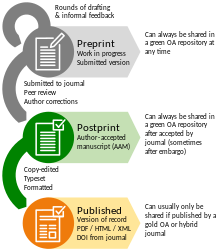
In academic publishing, a preprint is a version of a scholarly or scientific newspaper that precedes formal peer review and publication in a peer-reviewed scholarly or scientific journal. The preprint may be available, oftentimes equally a non-typeset version available costless, before or after a paper is published in a journal.
History [edit]
Since 1991, preprints have increasingly been distributed electronically on the Internet, rather than as paper copies. This has given rising to massive preprint databases such as arXiv and HAL (open archive) etc. to institutional repositories. The sharing of preprints goes back to at least the 1960s, when the National Institutes of Wellness circulated biological preprints. Afterwards six years the utilize of these Data Exchange Groups was stopped, partially because journals stopped accepting submissions shared via these channels.[1] In 2017, the Medical Research Council started supporting citations of preprints in grant and fellowship applications,[2] and Wellcome Trust started accepting preprints in grant applications.[3]
In February 2017, a coalition of scientists and biomedical funding bodies including the National Institutes of Wellness, the Medical Research Council and the Wellcome Trust launched a proposal for a central site for life-sciences preprints.[iv] [five] [6] In February 2017, SciELO announced plans to ready upwardly a preprints server – SciELO Preprints.[7] In March 2017, the National Institutes for Health issued a new policy encouraging research preprint submissions.[8] [ix] In April 2017, Center for Open Science announced that information technology will exist launching 6 new preprint archives.[10] At the end of the 2010s, libraries and discovery tools increasingly integrate Unpaywall data, which indexes millions of preprints and other greenish open access sources and manages to serve over half of the requests by users without the demand for subscriptions.[11]
During the early months of the COVID-xix pandemic, the need for published research on the disease spurred a moving ridge of research manufactures existence released equally preprints,[12] bypassing the peer-review and publication process, which was proving too tedious in the context of an agile and novel pandemic. The release of COVID-related preprint articles, along with other COVID-related articles published by traditional journals, contributed to the largest ever single-year increase in scholarly articles.[thirteen]
Part [edit]
Academic practices [edit]
Publication of manuscripts in a peer-reviewed journal often takes weeks, months or even years from the fourth dimension of initial submission, owing to the time required by editors and reviewers to evaluate and critique manuscripts, and the time required by authors to accost critiques. The demand to quickly circulate electric current results within a scholarly community has led researchers to distribute documents known as preprints, which are manuscripts that take nonetheless to undergo peer review. The firsthand distribution of preprints allows authors to receive early feedback from their peers, which may be helpful in revising and preparing articles for submission.[xiv] Preprint are also used to demonstrate the precedence of the discoveries and a fashion to protect the intellectual belongings (a prompt availability of the discovery can exist used to block patenting or discourage competing parties).
Most publishers allow work to exist published to preprint servers before submission. A minority of publishers determine on a case-by-case basis or interpret the Ingelfinger Dominion to disqualify from submission.[fifteen] Withal, many journals prohibit or discourage the utilize of preprints in the references every bit they are not considered as credible sources.
Some journal-independent review services (Peerage of Science, Peer Community In, Review Commons, eLife Preprint Review) offer peer review on preprints. These peer-reviews are either a start step before publication in a journal (Peerage of Science, Review Commons, eLife Preprint Review) or effect in a formal editorial decision (Peer Community In) without precluding submission in journals.[sixteen]
Stages of printing [edit]
While a preprint is an article that has not yet undergone peer review, a postprint is an article which has been peer reviewed in preparation for publication in a periodical. Both the preprint and postprint may differ from the terminal published version of an article. Preprints and postprints together are referred to as e-prints or eprints.[17]
The word reprint refers to difficult copies of papers that accept already been published; reprints can be produced past the periodical publisher, but tin can also be generated from digital versions (for instance, from an electronic database of peer-reviewed journals), or from eprints self-archived by their authors in their institutional repositories.
Tenure and promotion [edit]
In academia, preprints are not probable to be weighed heavily when a scholar is evaluated for tenure or promotion, unless the preprint becomes the basis for a peer-reviewed publication.[18]
Some of import results in mathematics take been published simply on the preprint server arXiv.[19] [20] After nearly a century of effort past mathematicians, betwixt 2002 and 2003 the mathematician Grigori Perelman published a serial of preprint papers on the arXiv where he presented a proof of the Poincaré conjecture.[21] [22] [23] Perelman was offered both the prestigious $one 1000000 Millennium Prize and the Fields Medal for the mentioned piece of work published exclusively on arXiv, but he declined both prizes.[19]
Advantages of preprints [edit]
The advantages of preprints can be summarized equally: prompt dissemination of outcomes, contributes to free menstruation of information, increase chances of early on feedback and comments, increase number of citations, chances of academic collaborations, make authors enthusiastic, may reduce predatory publishing, increases transparency, may publish negative outcomes and controversies, may receive DOI, link to ORCID, plagiarism check, run a risk to receive grants and awards, promotion of immature researchers, early credit, proficient place for hypothesis, and early on detection of science misconduct.[12]
Disadvantages of preprints [edit]
The disadvantages of preprints could be summarized as: lack of peer-review, absence of quality (in controversy), concerns well-nigh premature data, media coverage not properly presenting the inherent dubiousness of preprints,[24] risk of double commendation (past publishing a peer- reviewed article, the preprint may likewise be cited), lack of upstanding and statistical guidelines, lack of respect for COPE or ICMJE guidelines, breach of intellectual property regulations in some countries, possible harm to health in certain cases, data overload, breach of Ingelfinger rule (a strategy conducted to discourage dissemination of research reports earlier they are published in the journal), rush to post low-quality research.[12]
Types of preprint servers [edit]
The preprint servers tin be grouped in three categories: general (accepting practically all preprints, frequently with bias towards some topic, publisher eastward.g. Authorea), field-specific (due east.m. bioRxiv, ChemRxiv) and regional (e.g. AfricArxiv, Arabixiv). Additionally, preprints tin can be categorised by the owner (private publishing visitor e.g. PeerJ PrePrints, libraries e.chiliad. EarthArXiv, universities e.grand. arXiv or independent non-profit organisations e.one thousand. HAL). While many preprint servers appeared, some had been terminated. The canceled servers were operated mainly past turn a profit publishing companies (e.g. Nature Publishing Group closed Nature Precedings or O'Reilly&SAGE closed PeerJ PrePrints) or were regional (e.thou. INArxiv limited to Indonesia). Moreover, multiple writing platforms (eastward.grand. Authorea) developed split up preprint servers equally a office of their service. For more complete list (over lx preprints servers) see: List of academic preprint repositories.
Run into also [edit]
- Electronic commodity
- Listing of academic preprint servers
- Listing of academic journals by preprint policy
- Offprint
- Prepress
- ScientificCommons
References [edit]
- ^ Cobb, Matthew (16 November 2017). "The prehistory of biology preprints: A forgotten experiment from the 1960s". PLOS Biology. 15 (eleven): e2003995. doi:x.1371/journal.pbio.2003995. PMC5690419. PMID 29145518.
- ^ "The MRC supports preprints". www.mrc.ac.united kingdom of great britain and northern ireland. Medical Research Council. 2017-01-03. Retrieved 2018-09-06 .
- ^ "We now accept preprints in grant applications". wellcome.ac.uk. Wellcome. Retrieved 2017-01-ten .
- ^ Callaway, Ewen (2017-02-16). "Heavyweight funders back fundamental site for life-sciences preprints". Nature. 542 (7641): 283–284. Bibcode:2017Natur.542..283C. doi:10.1038/nature.2017.21466. PMID 28202994. S2CID 4466963.
- ^ "Principles for establishing a Central Service for Preprints: a statement from a consortium of funders | ASAPbio". asapbio.org . Retrieved 2017-02-xiii .
- ^ "ASAPbio newsletter vol seven – Funders sign onto principles for preprint development, RFA released, scientific society town hall | ASAPbio". asapbio.org . Retrieved 2017-02-14 .
- ^ "SciELO Preprints on the way". SciELO in Perspective. 2017-02-22. Retrieved 2017-02-22 .
- ^ "Not-OD-17-050: Reporting Preprints and Other Interim Enquiry Products". grants.nih.gov . Retrieved 2017-03-25 .
- ^ "NIH enables investigators to include draft preprints in grant proposals". Scientific discipline | AAAS. 2017-03-24. Retrieved 2017-03-27 .
- ^ "Public Goods Infrastructure for Preprints and Innovation in Scholarly Advice". cos.io . Retrieved 2017-04-xix .
- ^ Dhakal, Kerry (15 Apr 2019). "Unpaywall". Periodical of the Medical Library Clan. 107 (two): 286–288. doi:10.5195/jmla.2019.650. PMC6466485.
- ^ a b c Heidary, Fatemeh; Gharebaghi, Reza (2021-05-31). "COVID-19 impact on enquiry and publication ideals". Medical Hypothesis, Discovery & Innovation in Ophthalmology. x (1): ane–four. doi:x.51329/mehdiophthal1414. ISSN 2322-3219.
- ^ "No revolution: COVID-19 boosted open up access, simply preprints are only a fraction of pandemic papers". Science. 2021-09-08. doi:10.1126/science.acx9058.
- ^ "Breaking Down Pros and Cons of Preprints in Biomedicine". Absolutely Perchance. 2016-05-01. Retrieved 2018-01-12 .
- ^ "Taking the online medicine". The Economist. ISSN 0013-0613. Retrieved 2016-03-23 .
- ^ "Comparison journal-independent review services". asapbio.org. ASAPbio. Retrieved 2021-01-22 .
- ^ "Self-archiving FAQ". EPrints.
- ^ Callaway, Ewen; Powell, Kendall (2016-02-18). "Biologists urged to hug a preprint". Nature. 530 (7590): 265. Bibcode:2016Natur.530..265C. doi:10.1038/530265a. PMID 26887471.
- ^ a b Kaufman, Marc (July 2, 2010), "Russian mathematician wins $1 million prize, but he appears to be happy with $0", Washington Post
- ^ Nadejda Lobastova and Michael Hirst, "Maths genius living in poverty", Sydney Morning Herald, August 21, 2006
- ^ Perelman, Grisha (November eleven, 2002). "The entropy formula for the Ricci flow and its geometric applications". arXiv:math.DG/0211159.
- ^ Perelman, Grisha (10 March 2003). "Ricci flow with surgery on 3-manifolds". arXiv:math.DG/0303109.
- ^ Perelman, Grisha (July 17, 2003). "Finite extinction time for the solutions to the Ricci menstruum on sure iii-manifolds". arXiv:math.DG/0307245.
- ^ Besançon, Lonni; Peiffer-Smadja, Nathan; Segalas, Corentin; Jiang, Haiting; Masuzzo, Paola; Smout, Cooper; Billy, Eric; Deforet, Maxime; Leyrat, Clémence (2020). "Open Scientific discipline Saves Lives: Lessons from the COVID-19 Pandemic". BMC Medical Inquiry Methodology. 21 (i): 117. doi:10.1186/s12874-021-01304-y. PMC8179078. PMID 34090351.
External links [edit]
- Eysenbach G. "The impact of preprint servers and electronic publishing on biomedical enquiry". Curr Opin Immunol. 2000 Oct;12(v):499–503
- Eysenbach One thousand. "Challenges and changing roles for medical journals in the cyberspace historic period: Electronic pre-prints and eastward-papers". J Med Internet Res 1999;1(two):e9
- Electronic Preprints and Postprints, in Encyclopedia of Library and Information Science. Marcel Dekker.
- Inefuku, Harrison W. "Pre-Print, Mail service-Print or Offprint? A Guide to publication versions, permissions and the digital repository." Ames, IA: Digital Repository @ Iowa State University, 14 Jan 2013.
- Journal policies on preprints from Nature Precedings forum
- Pre-print, mail-print, definitions and terms as defined by SHERPA (organisation)
- Preprint, Postprint as defined by Crossref
- Preprint FAQ past ASAPbio.
Source: https://en.wikipedia.org/wiki/Preprint
0 Response to "A Word for Review Your Copy Before You Publish"
Post a Comment