How to Open Draw 9 Patch Tool
It's a widely held impression that the Patched Masters were exactly that: Edgar Lee Masters, such as da Vinci and Vermeer, who multicoloured in cleanly precise freehand. On that point are savants with firm hands, zero question. Simply thither are other techniques to moot, which David Hockney (an artist of our age who also pioneered iPad art), expounds on in Secret Knowledge: Rediscovering the Destroyed Techniques of the Old Masters, in which he lays retired on the nose how European painters used mirrors and lenses to create their compositionally perfect portraits.
That surprised Golan Levin, an interaction designer and a tech operation artist of sorts–and one of Fast Company's people shaping the time to come of design in 2012. Wherefore? "Mostly because it seemed like a truth, merely none of my colleagues talked about it," he tells Carbon monoxide gas.Plan. Levin teaches at Carnegie Mellon and also sits on the admission staff. "All these students come to me from high school, and they think art equals picture, and painting equals lifelike painting. They're being put up to conceive they need godlike powers."
Pablo Garcia, an art prof at the School of the Art Establish in Chicago, has been informed the (controversial) musical theme for some years and has amassed an all-embracing aggregation of optics. He offered to let Levin try a camera lucida, one of the tools Hockney says the Old Masters used to capture their subjects more realistically. Levin loved it, and the yoke decided to make a 21st-century version.
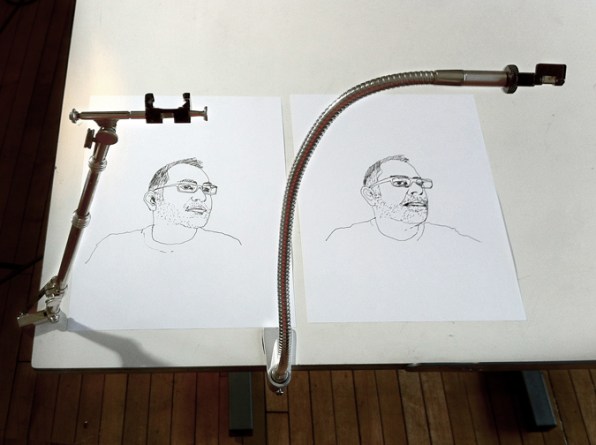
A camera lucida is a simple automobile: A slim prism reflects the image of the subjugate so the watcher can go steady their own hand, addition the image, and trace a more accurate rendition onto the paper. The effect International Relations and Security Network't far off from the Google Glass video demos we've been beholding. There are layers of images available in your line of sight–for you to use in some smart way. Only the only lucidas yet available are collectibles, and run a price mark north of $300–more than Levin and Garcia believed college students would pay. American Samoa IT turns outer, manufacturing just several lucidas costs $20,000, only each additional prism costs meet pennies.
Which is wherefore the NeoLucida sells for $30. IT's stark for Kickstarter. Since launching the product on May 8, Levin and Garcia are already hearing from people who missed out on the first 2,500 they made available. But unlike most other uncontrolled Kickstarter hits, this isn't–or wasn't–divinatory to be a business. "This undiversified thing is a performance, or an intervention, or just artwork," Levin says. Fortuitously, the project had enough ask and interest so that only two days afterward going live, Levin and Garcia confirmed that thither will be an unlimited second production run, conducted aside professional manufacturers.
The effects of getting the NeoLucidas KO'd into the market should be riveting. Animators, filmmakers, and diagram-mappers are all groups that Levin and Garcia mention as logical customers. Because for all the advancements we get with graphic instance and picture taking, people still want roll up their sleeves and puff look-alike an old master.
The project has already raised about $400,000, furthermost beyond its end of $15,000. Support the hunting expedition hither.
Source: https://www.fastcompany.com/1672559/kickstarting-a-30-optical-tool-for-drawing-with-camera-like-accuracy
0 Response to "How to Open Draw 9 Patch Tool"
Post a Comment